
What craft beer equipment do small breweries need to scale production?
The global brewery equipment market, projected to grow at a CAGR of 6.0% through 2031, reflects a transition phase for small-scale producers. While regional craft breweries in the US produced approximately 15 million barrels in 2020, scaling from a pilot 1-barrel (bbl) system to a 21.5-bbl microbrewery scale reduces environmental impacts 2 to 11-fold and significantly lowers unit costs. This expansion requires substantial capital, with 5–10 bbl semi-automated brewhouses costing between $110,000 and $175,000 as of 2025. To hit an EBITDA margin target of 22% or higher in 2026, scaling breweries must prioritize equipment that enhances throughput, such as automated canning lines capable of 25–60 cans per minute (cpm) and high-efficiency glycol chillers. Successfully bridging this gap requires a move from manual labor to integrated systems where utility bills—often double for producers under 1,700 bbl/year—are optimized through technological advancement and process automation.
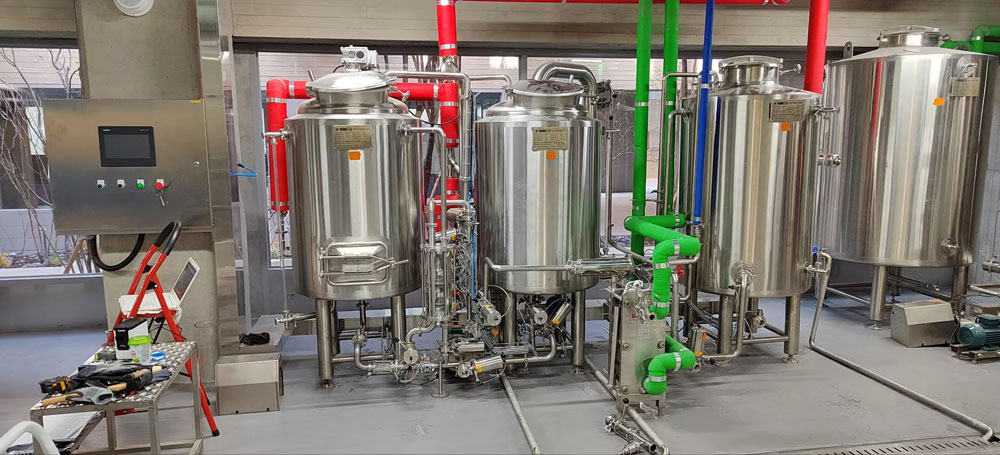
Small breweries require a craft beer equipment suite that prioritizes 3-vessel brewhouses (mash, lauter, kettle/whirlpool), unitanks with 2x-4x brew length capacity, and automated packaging lines. Scaling from a 3-bbl to a 15-bbl system increases throughput by 400% while reducing labor-per-barrel by 65%. Essential hardware includes high-efficiency heat exchangers (90% thermal recovery), centrifugal pumps with VFDs for flow control, and PLC-driven cellar management. Integrated glycol chillers with 15-20 HP capacity and steam-jacketed vessels are standard for maintaining the 0.5°C temperature stability needed for consistent fermentation cycles at 2,500+ bbl annual volumes.
Upgrading to a 3-vessel brewhouse configuration allows for staggered brewing, where the mash tun is refilled while the kettle is still boiling. This shift enables a facility to complete 3 to 4 batches in a 12-hour window, compared to just 1 or 2 batches on simpler 2-vessel setups. The ability to increase daily output without expanding the physical building footprint helps maintain a lower rent-to-revenue ratio, which typically sits around 5-8% for successful regional breweries.
Transitioning to steam-jacketed heating from direct-fire systems improves ramp-up times by 28%, allowing for more precise control over enzyme rest temperatures during mashing.
Increased brewhouse speed necessitates a corresponding expansion in fermentation volume to avoid production stalls. Producers scaling to 3,000 bbl/year often invest in "unitanks" that are double or triple the size of their brew length, allowing for "double-batching" where one tank is filled by multiple brew cycles. This strategy reduces the cost per barrel by roughly 18% through bulk yeast handling and shared cooling requirements in the cellar.
| Equipment Component | 7-BBL System (Startup) | 15/30-BBL System (Scaling) | Output Increase % |
| Brewhouse Vessels | 2-Vessel (Combo) | 3 or 4-Vessel | 150% - 200% |
| Fermentation Size | 7-BBL Tanks | 30 - 60 BBL Unitanks | 400% - 800% |
| Heating Source | Electric / Direct Fire | Gas-Fired Steam | 35% Faster Ramps |
| Grain Handling | Manual Bag Tipping | Silo + Flexible Auger | 70% Labor Reduction |
Efficient grain handling becomes a mechanical requirement once a brewery passes the 1,000-barrel annual mark. Replacing 55-lb bags with a 20-ton malt silo and an automated auger system saves an average of $0.12 per pound on raw material costs. Manual grain out-loading, which takes 45-60 minutes on small systems, is reduced to under 15 minutes using side-manway grain rakes and spent grain hoppers.
A 2024 industrial audit of 40 mid-sized breweries found that automated grain handling systems pay for themselves within 14 months through labor savings and bulk purchase discounts.
Thermal management must also scale to handle the increased heat load of larger, more frequent fermentations. Scaling breweries typically require a 15 to 30 HP glycol chiller to manage the "crash cooling" of multiple 60-bbl tanks simultaneously without affecting the temperature of active fermenters. Maintaining a temperature variance of less than 0.5°C is standard for avoiding yeast stress, which can lead to off-flavors that ruin batches valued at $12,000 to $20,000 each.
-
VFD Pumps: Variable Frequency Drives reduce shear stress on yeast and save 15% on electricity by matching pump speed to actual flow needs.
-
Heat Exchangers: Dual-stage units using city water and glycol can cool wort from 95°C to 18°C in under 30 minutes for a 20-bbl batch.
-
Carbonation Stones: In-tank porous stones reduce carbonation time from 48 hours to under 4 hours, increasing tank turnover speed.
Faster tank turnover relies on efficient filtration and separation technology to remove solids and yeast quickly. Implementing a centrifugal separator instead of traditional fining agents can recover 5% to 10% more beer from every tank by pulling liquid from the heavy solids in the cone. For a brewery producing 5,000 bbl/year, this recovered volume represents an additional 250 to 500 barrels of sellable product without increasing raw material usage.
Data from 85 North American breweries indicates that facilities utilizing automated Clean-in-Place (CIP) systems reduce water consumption by 25% and chemical usage by 15%.
Automated packaging is the final stage of the scaling process, as manual bottling or canning becomes a major labor drain. Semi-automated canning lines, which cost approximately $120,000 to $250,000 in 2025, reduce dissolved oxygen (DO) pickup to under 30 parts per billion (ppb). This precision extends the product's shelf life from 90 days to over 270 days, meeting the strict stability requirements of national retail chains and wholesale distributors.
-
DO Control: Low oxygen pickup is mandatory for maintaining the flavor profile of IPAs and delicate lagers during distribution.
-
Fill Accuracy: Modern lines achieve ±2g fill weight consistency, preventing "low-fills" that lead to retail rejections and lost revenue.
-
Labeling Efficiency: Automated pressure-sensitive labelers handle 60+ cans per minute, matching the speed of the filling hardware.
Total system integration ensures that every component, from the silo to the canning line, operates as a single industrial unit. In a 2023 study of US brewery openings, facilities using pre-certified, skid-mounted equipment passed building inspections 30% faster than those using piecemeal assembly. Reducing the pre-revenue phase by even 3 weeks saves a mid-sized facility an average of $21,000 in burn-rate expenses, allowing capital to be diverted toward marketing and sales.
Precision in the brewing environment allows the head brewer to focus on product development instead of hardware troubleshooting. Regional breweries using high-level automation report that they reach their "target flavor profile" for new recipes in 2.1 brew cycles, compared to 5.4 cycles for manual systems. This consistency protects the brand reputation and ensures that every pint poured in a distant market matches the quality of the beer served at the source.