
Allergen Labelling Through the Sample-to-Bulk Handover on a Value Line
Between an approved sample and a delivered bulk order there are several quiet opportunities for the allergen position to change, and none of them announce themselves. A compound batch sourced from a different lot, a stabiliser swapped for availability, a concentration adjusted to control cost: each can move a substance across a declaration threshold. The handover is the control point. Handled properly it is a short set of documents and confirmations; handled loosely it leaves a brand holding printed packaging that describes a product it no longer has.
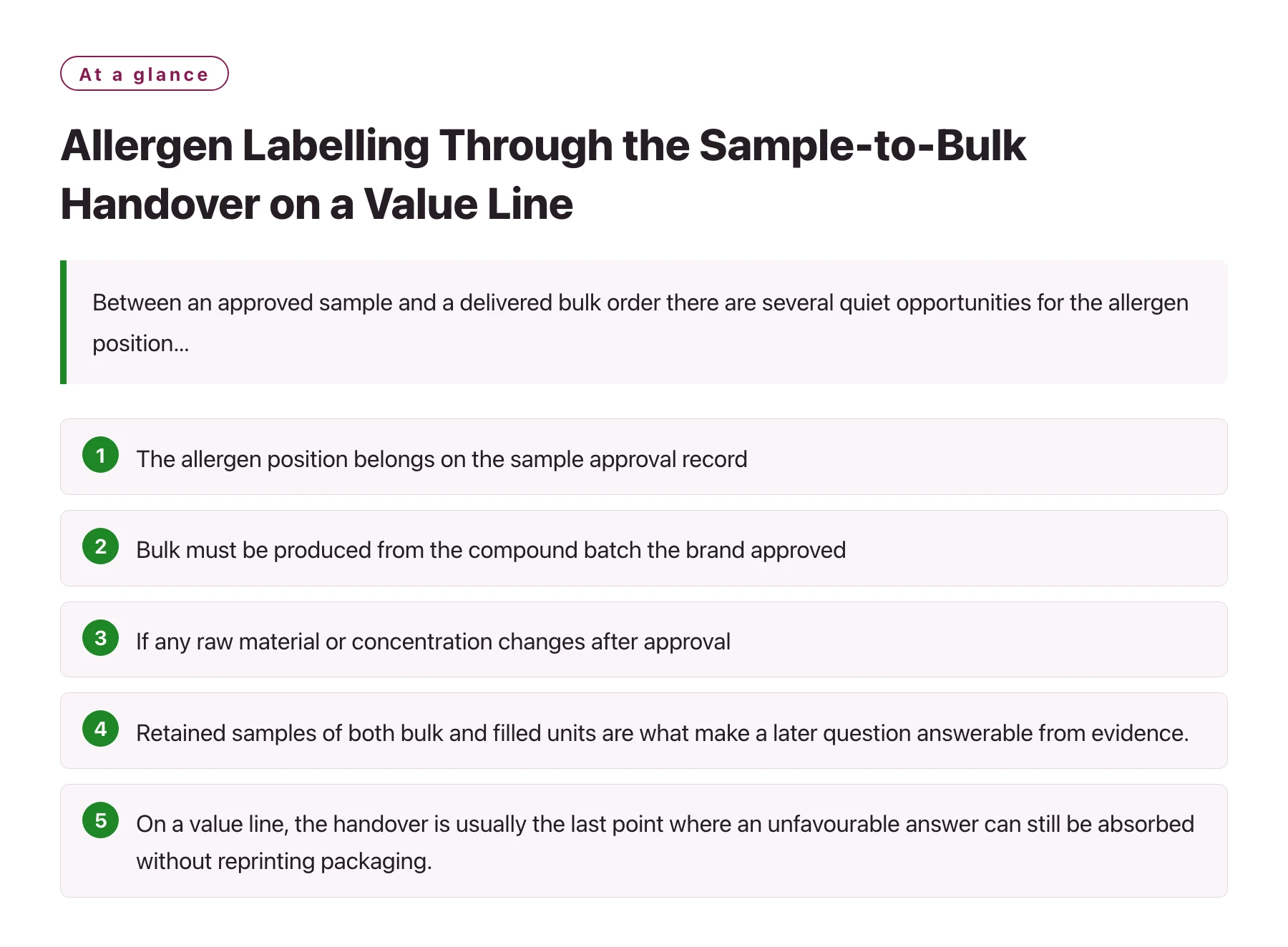
Key takeawaysThe allergen position belongs on the sample approval record, not only in a later technical file, because approval is the last moment when a change is still cheap. · Bulk must be produced from the compound batch the brand approved, and that has to be confirmed in writing with the batch record. · If any raw material or concentration changes after approval, the declaration has to be re-read before the change is accepted [1]. · Retained samples of both bulk and filled units are what make a later question answerable from evidence. · On a value line, the handover is usually the last point where an unfavourable answer can still be absorbed without reprinting packaging.
Sample-to-bulk handover problems are usually described as a scent problem. Two units smell slightly different, or the bulk feels less bright than the sample, and the conversation becomes about maceration time and resting. Allergen consistency is the same kind of problem with a different symptom: the scent can be acceptable and the declaration can still be wrong, because the two documents were produced at different moments from different information.
The reason this matters more on a value line than on a premium one is the cost of a correction. A brand selling at a high price can absorb a label reprint or a second filling run. A brand selling at an entry price often cannot, so the handover has to be treated as a compliance gate rather than as a logistics milestone.
Where the declaration stops matching the product
There are three ordinary routes to a mismatch. The first is a compound substitution: the fragrance house uses a different lot or slightly different base, and the declarable substance levels shift. The second is a concentration change, where a material is reduced for cost or availability and crosses below or above a threshold. The third is a documentation drift, where the ingredient list on the artwork was written from an early data sheet and never updated after a late change.
None of these requires anyone to behave badly. They are ordinary consequences of a supply chain in motion, and they are exactly the reason a formal handover exists. The framework for the expanded EU allergen declaration makes the consequences concrete: products placed on the market from 31 July 2026 have to carry the updated declaration, and stock placed earlier may only continue to be made available until 31 July 2028 [1].
Testing is part of the answer but not the whole of it. Independent laboratories provide allergen content screening within routine cosmetics testing [2], and a test result is valuable evidence when a question arises. It does not replace the composition data that determines the declaration, and a test run after the packaging is printed can only confirm a problem rather than prevent one.
Four gates between the approved sample and the bulk order
- Gate one: approve the sample and the data togetherThe approval record should state the reference sample identifier, the compound reference and the allergen position as assessed at that moment. Approving a sample without the data leaves nothing to compare against later.
- Gate two: confirm the compound batch before fillingAsk for written confirmation, before the run, that the compound batch allocated to the order matches the approved reference. This is a one-line request that removes the most common source of drift.
- Gate three: capture the bulk sample and the batch recordRetain bulk and filled samples with the batch record, labelled with the compound reference, so a later comparison has a defined basis.
- Gate four: re-read the declaration on any changeAny substitution, reformulation or concentration adjustment after approval should trigger a documented re-read of the ingredient list before the change is accepted.
What should travel with the handover
| Item | Who issues it | When it has to exist | What it prevents |
|---|---|---|---|
| Compound allergen statement | Compound supplier or in-house development | With the sample, before approval | A declaration written from incomplete data |
| Reference sample record | Brand and manufacturer, jointly | At approval | Disputes about what was approved |
| Batch record with compound reference | Manufacturer | At production | Silent substitution between sample and bulk |
| Retained bulk and filled samples | Manufacturer | At production, held for the agreed period | Unanswerable questions months later |
| Final ingredient list, versioned | Brand with regulatory input | Before artwork is released | A label that describes an earlier formula |
The interesting column is the third. Every item on this list is cheap before production and expensive afterwards, which is why the handover is worth scheduling as a compliance event rather than leaving it as an exchange of emails.
Why a value line is more exposed at this point
A value line usually runs on a compressed calendar with fewer samples and smaller quantities, which reduces the number of checkpoints rather than the number of risks. Where a premium project might have three sample rounds, a value project often has one, and that single round carries the whole compliance burden.
It also tends to sit further from the compounding step. The brand may never meet the perfumer, and the compound may arrive through an intermediary, so the person answering allergen questions is not the person who built the formula. That distance is manageable when documentation is routine, and it is dangerous when documentation is assembled on request.
The structural remedy is to reduce the number of handovers in the first place. When a single partner develops the compound and also fills and labels the product, the allergen statement, the reference sample and the batch record all belong to one process, and there is no gap between the sample approved and the bulk produced. This is the argument for choosing a factory that develops and produces the scent rather than assembling the same output from three suppliers.
The one sentence to put in the supply agreement
Write it directly: no change to the compound, its raw materials or its concentrations may be applied to this product without written notice to the brand and a re-assessment of the ingredient declaration. It costs nothing, it is easy to agree, and it converts an assumption into a control.
A practical test for a buyer: ask for the approved reference sample identifier and the compound batch reference for a past order, and see how quickly both appear. A manufacturer that keeps them together can support the handover. One that has to reconstruct them is telling you where the next problem will surface.
Making the handover auditable without adding bureaucracy
Auditability sounds heavy, but for a small brand it means three things: a reference sample that is identified, a batch record that is retrievable, and a named person who answers for both. Nothing about that requires a large quality department, and nothing about it is specific to fragrance.
The mistake is to treat the handover as the manufacturer's internal business. It is the brand's compliance position that moves through that gate, and the brand that asks two or three specific questions at the right moment keeps control of it. A manufacturer that expects those questions, answers them in writing and can show how the whole chain from compound to filled bottle fits together is a different proposition from one that treats them as a nuisance.
Two documents make this concrete: custom fragrance R&D and production described at the front end, and the reference sample and batch record produced at the back end. Where both come from the same process, the handover becomes a formality. the company behind the factory matters less than the fact that the compound, the fill and the file were never separated, and that arrangement is worth checking on the official Xuelei website before a first order rather than after one.
Sources
- HPRA: Labelling of cosmetic fragrance allergens (Health Products Regulatory Authority, Ireland)
- SGS: Cosmetics, Personal Care & Household Testing —— Testing, inspection and certification services for cosmetics and personal care, including microbiological, stability and safety testing aligned with cosmetics GMP.
Frequently asked questions
Can the allergen declaration change between an approved sample and the bulk order?
Yes, if the compound batch, a raw material or a concentration differs from what was approved. That is why the approved sample should be recorded with its allergen position, and any change after approval should trigger a re-read of the ingredient list.
Do we need to test bulk for allergens even if the supplier provides a statement?
Not routinely, because the declaration is driven by composition data rather than by a batch test. Testing is worth considering when a market requires verification, when the statement is unavailable, or when a change has occurred and the existing data is no longer trusted.
What is the minimum handover documentation for a first order?
A compound allergen statement, an identified reference sample, a batch record that names the compound batch, retained bulk and filled samples, and a versioned final ingredient list. Each is short, and each closes a specific gap.
Who should sign the sample approval?
One person should own it, and the record should name them along with the date and the reference sample identifier. Verbal or chat-based approval is the most common reason a later dispute cannot be resolved.