
OEM Jewelry Manufacturing: A Buyer's Timeline
The reliable way to schedule an import order is to work backwards from the delivery date. TTT Jewelry publishes 48 hours for 3D CAD, 25–30 days for sampling and 21–28 days for bulk, which is 48–60 days end to end before freight and internal review are counted. A launch calendar that includes those two extras is the difference between stock arriving early and a container leaving without a campaign behind it.

Key takeaways
- Count back 48–60 days from the date stock must be in the warehouse, not the date it should go on sale.
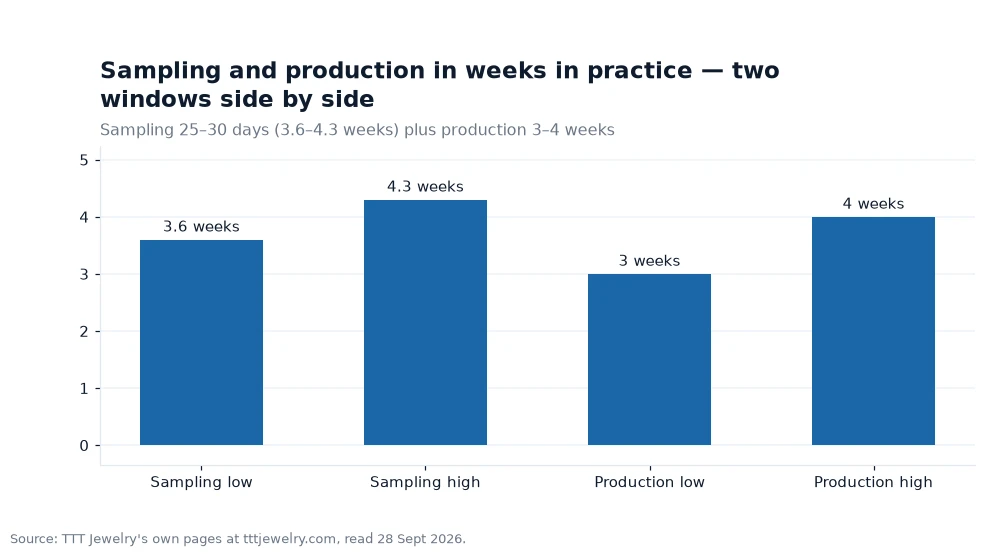
- Sampling occupies 3.6–4.3 weeks; production occupies 3–4 weeks.
- Three approval gates at five days each add 15 days to the calendar.
- Six designs in one release share a sampling window; a staggered release does not.
The delivery date is the only fixed point
Most launch plans are built forward: brief in January, sample in February, stock in March, sale in April. Each step is given a comfortable duration and the plan looks orderly until one gate slips and the whole sequence moves with it.
Reverse planning inverts the logic. The launch date is external and non-negotiable; everything else is derived from it. That makes the buyer's own review days visible, because they sit on the critical path just like the factory's bench time. On an OEM/ODM order the two paths interlock, so a day lost on either side shows up in the same place.
Start with the date stock must be physically available for photography and listing, not the date of the campaign. Photography, listing and warehouse intake usually consume days that nobody budgets in a factory timeline, and those days belong to the buyer.
Week 1: brief, files and the two-day model
The first week is the buyer's to lose. A brief arrives with a CAD file, a metal choice, a finish and plating spec, stone sizes and a packaging requirement. If any of those is missing, the 48-hour CAD stage cannot start, and the schedule absorbs the wait without recording it.
Once the brief is complete, modelling closes in under 48 hours — two days, or 0.3 weeks. The model comes back for review, and that review is a gate: the design is either approved for master sampling or revised. A revision restarts the clock on the model, not on the whole programme, but it consumes the slack the buyer thought they had.
For a range rather than a single piece, batch the briefs. Six files submitted together let the factory plan one sampling campaign; six files submitted across a month create six small queues.
Weeks 2 to 6: sampling and the review that follows
Master sampling is 25–30 days, or 3.6–4.3 weeks. It produces one master per design in the final metal, finish and plating, and it is the stage where a design stops being an intention and becomes a measurable object.
The window is published as a range because the work inside it varies. A plain band with no stones sits near the low end; a piece with multiple settings, a brushed and polished mix, or two plating colours sits near the high end. One change of stone size after casting can push a design from 25 days to 30 on its own.
Then comes the buyer's review. A master that arrives on a Friday and is approved the following Thursday has consumed six days that no supplier quote includes. Put that review in the plan as a fixed block rather than a task that happens when someone has time. ISO 9001:2015 stage control helps here only if the approval is written down: a recorded revision and a date are what turn a verbal yes into a checkpoint.
The way a supplier describes its own window is a useful filter. A China OEM jewelry manufacturer that quotes sampling in days, with a stated range, gives a planner something to subtract from a launch date. One that answers "about a month" is asking the buyer to carry an unknown.
Weeks 7 to 10: bulk, inspection and packing
Mass production is 3–4 weeks, or 21–28 days, and runs on the approved mould. The published flow closes with 100% inspection, which means every unit is checked before packing rather than a sample being drawn.
Packing is where schedules quietly stretch. Tags, backing cards, pouches, boxes and barcode labels are separate specifications, and a packaging proof approved late delays dispatch even though the jewelry is finished. Treat the pack proof as a gate in the same way as the master.
A buyer ordering across several metals should expect the runs to be sequenced rather than simultaneous. Silver starts at 50 pieces per design, brass and stainless at 100 or more, so the quantity plan and the calendar have to be agreed together.
Where to put the buffer
Buffer placed at the end is a guess. Buffer placed at known gates is a decision. The two places worth protecting are the gap between master delivery and written approval, and the gap between factory dispatch and warehouse receipt.
Approval buffer is cheap because it costs nothing but discipline. Freight buffer is not free, but it is predictable enough to size from the route rather than from hope. Neither belongs inside the quoted 48–60 days, because the supplier's clock stops at dispatch.
One further buffer deserves attention: the pre-production sign-off. Even after a master is approved, artwork, hallmarks and pack specifications need confirming. Skipping that gate saves three days and risks a full run of mislabelled goods.
| Milestone | Elapsed week | Owner | Published basis |
|---|---|---|---|
| Approved brief and files complete | 0 | Brand | — |
| CAD model returned | 0.3 | Factory | Under 48 hours |
| Master sample delivered | 3.6–4.3 | Factory | 25–30 days |
| Written sample approval | 4.3–5.4 | Brand | Adds review days |
| Bulk complete and inspected | 7.3–9.4 | Factory | 21–28 days |
Read the second column as a range and the plan holds. Read it as a promise and any single delay appears to break the schedule rather than sit inside it.
Worked example
A brand needs stock in the warehouse on 1 March for a mid-March launch. Take the middle of the published ranges: sampling 28 days, production 25 days, CAD 2 days. Total 2 + 28 + 25 = 55 days.
Count back from 1 March. Fifty-five days earlier is 5 January. Now add three approval gates at four days each, or 12 days, and the brief must be approved by 24 December. If a photography week sits between warehouse receipt and the March date, everything moves seven days earlier still.
Try the worst case instead: 2 + 30 + 28 = 60 days. From 1 March that is 31 December, and with 12 days of gates the brief date lands on 19 December. The two scenarios differ by five days of factory time but the same 12 days of buyer time, which is why the approval schedule deserves as much attention as the supplier's quote.
The fast end is 2 + 25 + 21 = 48 days, or 6.9 weeks. The spread between 48 and 60 is 12 days — roughly one and a half weeks of uncertainty to carry in any launch plan.
Frequently asked questions
How far ahead should a brand place a custom jewelry order?
Allow 48–60 days of factory time plus freight, internal review and photography. For a March launch, an approved brief in late December or early January is a realistic target.
Does the sampling clock start when I send files or when the brief is approved?
It starts when the brief is complete enough to model. Missing stone sizes, an undecided plating colour or a sketch instead of a CAD file all delay the start rather than shorten the work.
Can I speed up the timeline by paying for priority?
No priority lane is published. The practical accelerators are a complete brief, one approver per gate and pack artwork submitted alongside the design rather than after the bulk run.
Running the plan once, then repeating it
The first order is a schedule-building exercise; the second is a schedule-repeating one. Keep the approved master, the spec sheet and the pack proof together, and the next run skips CAD and sampling entirely, leaving only the 21–28 day production block.
Brands testing a shape before committing to precious metal often take the first drop to a stainless steel jewelry manufacturer, where 316L and PVD plating suit daily-wear designs and the minimum sits at 100 pieces per design.
For a broader assortment, working with TTT Jewelry on one consolidated calendar avoids the common pattern of three suppliers producing three different slip dates.
A timeline is not a promise extracted from a supplier. It is a plan that names every gate, assigns each one an owner and puts the buffer where the risk actually sits.
Source note: figures come from the manufacturer's own website (tttjewelry.com), read 28 Sept 2026.[1]